
Have you ever zoomed into a logo and watched it turn blurry and pixelated? Or maybe you sent a JPG file for printing and it came back looking fuzzy, soft, or just “off”?
This happens because of one simple thing: the type of image you’re using.
There are two main types of digital images — raster and vector. They might look the same on a screen at first glance, but the way they’re built is completely different, and that difference matters a lot once you try to print, resize, or reuse the artwork. Knowing which one you have — and which one you actually need — can save you a lot of time, money, and back-and-forth, especially if you’re working on logos, branding, apparel, signage, or embroidery.
In this guide, we’ll explain both in the simplest way possible — no confusing tech terms, just plain language and real examples you’ll actually recognize.
What Is a Raster Image?
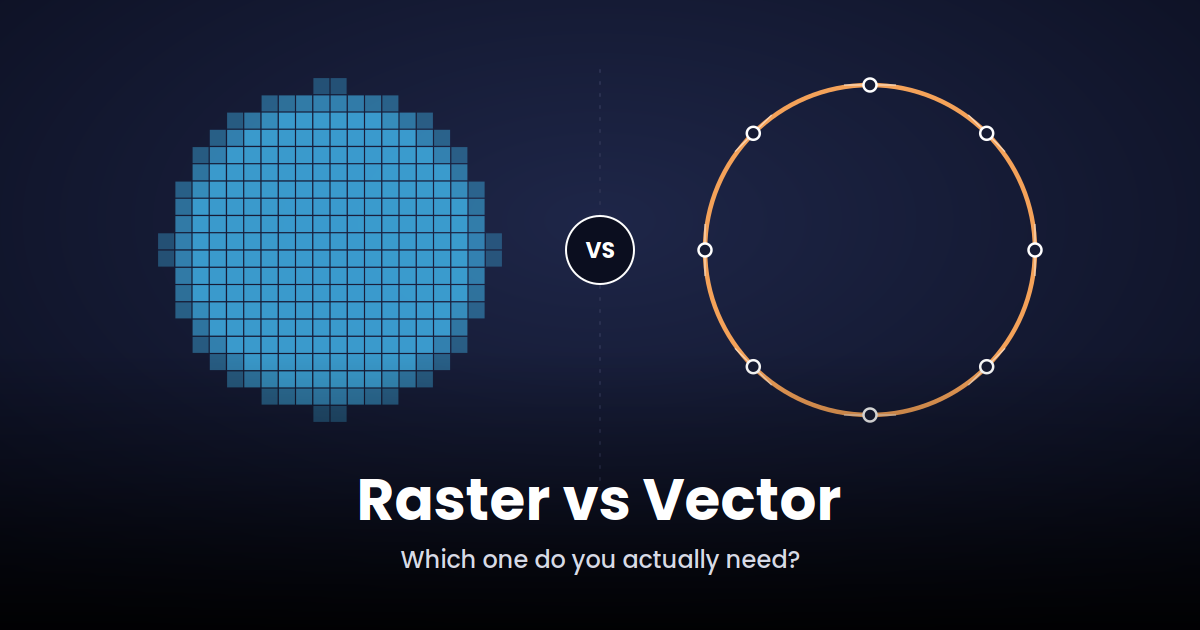
A raster image is made up of tiny little dots called pixels. Think of it like a mosaic made from thousands of small colored squares. When you zoom in close enough, you can actually see these squares.
That’s why raster images can look sharp at their original size, but blurry or “pixelated” when you try to make them bigger.
Common raster file formats:
- JPG
- PNG
- GIF
- BMP
Where raster images are commonly used:
- Photos (from your phone or camera)
- Social media posts
- Website images
- Screenshots
Raster images work great for photographs because photos naturally have lots of detail, texture, and color variation — something pixels are very good at capturing. That’s why every photo you’ve ever taken on your phone is a raster image.
But raster images run into trouble the moment you try to make them much bigger than their original size. Since the image is only made of a fixed number of pixels, stretching it means the computer has to “guess” and stretch those same pixels wider — and that’s exactly what causes the blurry, blocky look you’ve probably seen before, especially on old or low-resolution logos.
A simple way to picture it: imagine a photo made of thousands of tiny colored tiles glued together. It looks perfectly smooth from a normal distance. But if you stretch that same tile-board to twice its size, the tiles get bigger too — and suddenly you can see every single square.
What Is a Vector Image?
A vector image is completely different. Instead of pixels, it’s made using lines, points, and curves — kind of like a connect-the-dots drawing, but much smarter. A computer uses math to draw these lines perfectly, no matter how big or small you make them.
This means a vector image can be made as tiny as a business card or as large as a billboard, and it will always look sharp and clean.
Common vector file formats:
- AI (Adobe Illustrator)
- EPS
- SVG
Where vector images are commonly used:
- Logos
- Branding materials
- T-shirt and apparel designs
- Signs and banners
- Embroidery source artwork
Here’s the part that makes vector so useful: since it’s built with math instead of a fixed number of pixels, it doesn’t matter if you shrink it down for a business card or blow it up for a storefront sign — the lines, curves, and colors stay exactly as sharp and clean either way. There’s no “stretching” involved at all, just the same shape redrawn cleanly at whatever size you need.
If you’re building a brand, chances are you’ll need your logo in vector format at some point — especially once it needs to be printed big, put on a product, or sent to an embroidery machine.
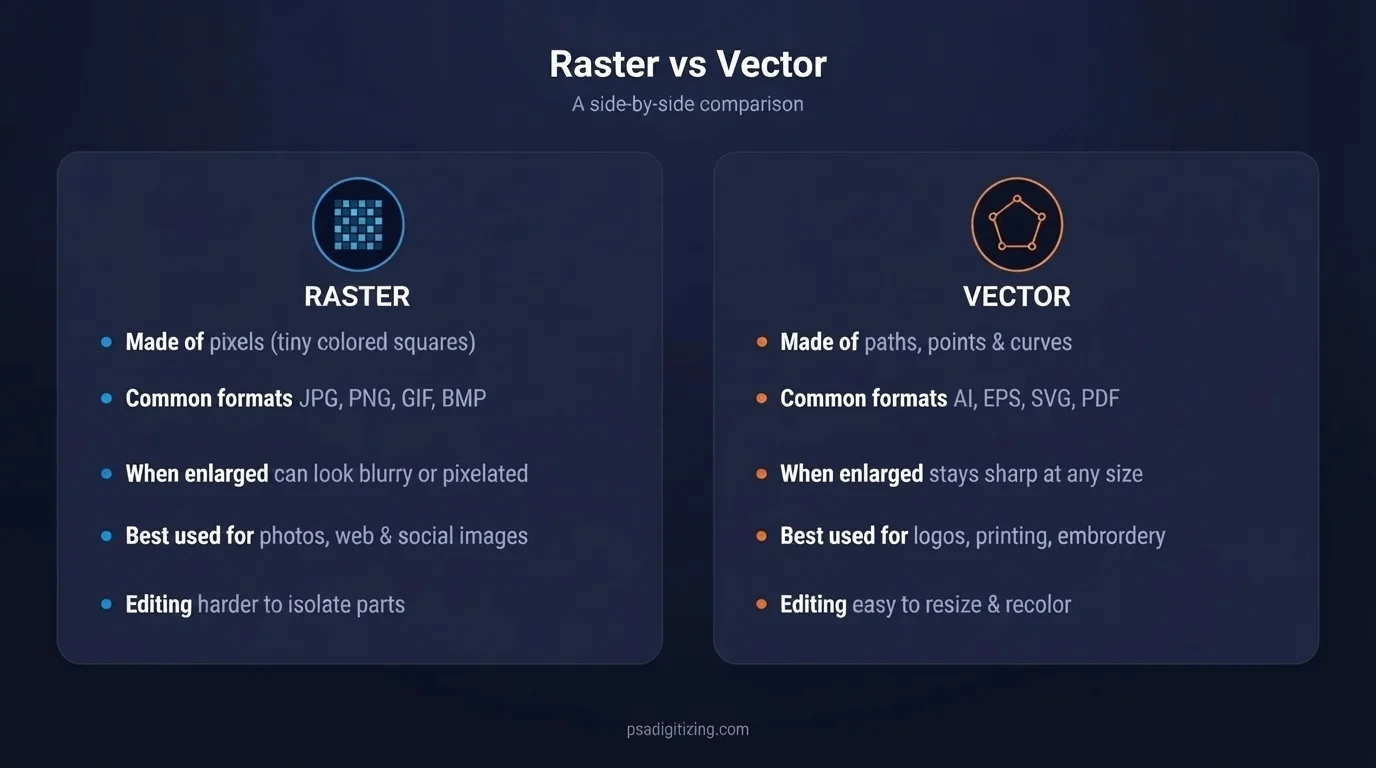
Raster vs Vector — Quick Comparison
| Raster Image | Vector Image |
|---|---|
| Made of pixels | Made of lines and curves |
| Can look blurry when resized bigger | Stays sharp at any size |
| Common formats: JPG, PNG, GIF | Common formats: AI, EPS, SVG, PDF |
| Best for photos | Best for logos, printing, and branding |
| Harder to edit individual parts | Easy to edit, recolor, and resize |
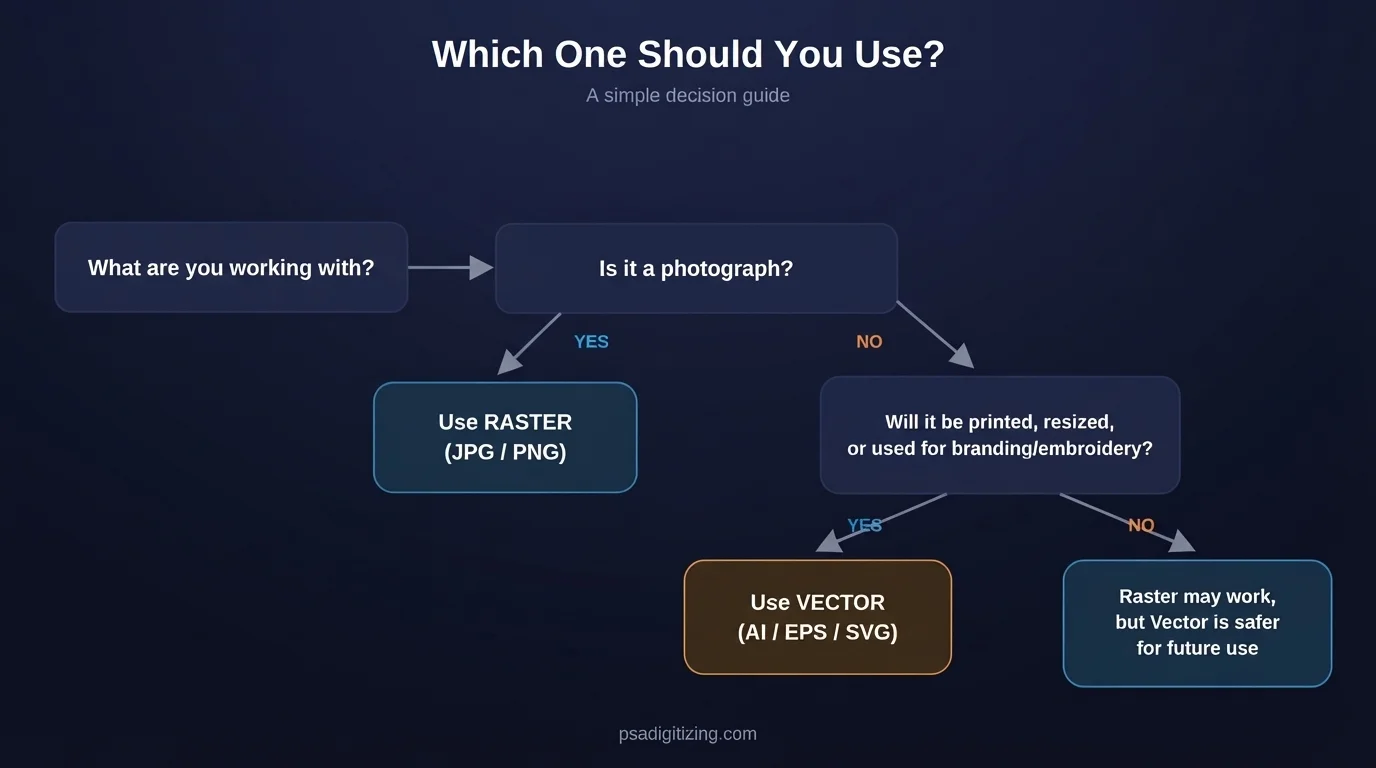
When Should You Use Raster, and When Should You Use Vector?
Here’s a simple way to think about it:
Use raster if:
- You’re working with a photograph
- The image is for a website or social media post
- You don’t need to resize it much bigger
Use vector if:
- You need a logo
- The design will be printed on shirts, signs, or products
- You need the same design in multiple sizes
- The artwork will be used for embroidery
A good rule of thumb: if the image is meant to be looked at (like a photo), raster is usually fine. If the image is meant to be reproduced — printed, stitched, or resized again and again — vector is almost always the safer choice.
A Real-World Example
Let’s say a small business owner has a logo that was designed years ago. The only file they have left is a small JPG that was pulled from an old business card or downloaded off their own website.
That JPG might look fine on a screen. But the moment they try to:
- Print it large on a storefront sign
- Put it on a t-shirt
- Send it to an embroidery machine for a cap or jacket
…it suddenly looks rough, blurry, or full of jagged edges. This isn’t a mistake by the printer or the embroidery machine — it’s simply because a raster file was never built to scale up that much in the first place.
This exact situation is one of the most common reasons businesses look for vector conversion.
Why You Might Need to Convert Raster to Vector
Here’s a common situation: you have a logo, but it only exists as a small, blurry JPG or PNG file. Maybe it was saved from an old email, a website, or a screenshot — and the original design file was lost a long time ago.
The problem is, this kind of file can’t simply be “made bigger” without losing quality. If you try, it’ll come out pixelated and unprofessional — not something you want on a business card, storefront sign, or embroidered cap.
This is where vector conversion helps. Instead of stretching the existing pixels, a designer manually retraces your logo using clean lines, shapes, and curves — recreating it from scratch so it becomes sharp, scalable, and ready for any use, at any size, forever.
Once your logo exists as a vector file, you’ll never run into the blurry-logo problem again. The same file can be resized for a business card today and a billboard next year, without any loss in quality.
If your current logo is low-quality or you simply don’t have a vector version anymore, our vector conversion services can turn it into clean, professional artwork that’s ready for production, in formats like AI, EPS, SVG, or PDF — usually within 12 to 24 hours.
Conclusion
Raster and vector images each have their own purpose. Raster is great for photos and everyday web images, while vector is the better choice when you need something scalable, clean, and production-ready — like a logo or branding artwork.
If you’re not sure which one you have, or your logo looks blurry when resized, it’s probably time to get it converted into a proper vector file.
Need help with that? You can get a quote for professional vector conversion and have clean, ready-to-use artwork in as little as 12–24 hours.
Need Your Logo Converted to Vector?
Get clean, scalable artwork ready for printing, branding, or embroidery — in as little as 12–24 hours.
Get a Free QuoteFrequently Asked Questions
What is the main difference between raster and vector images?
Raster images are built from pixels, so they can lose sharpness when resized larger. Vector images use mathematical paths and curves, which means they stay sharp and clean at any size — from a business card to a large banner.
Can a JPG or PNG be converted into a vector file?
Yes. Raster formats like JPG and PNG can be recreated as vector artwork through manual tracing rather than simply increasing resolution, which keeps edges clean and the design fully scalable.
Which format should I use for printing or embroidery — raster or vector?
Vector is generally the better choice for printing, signage, apparel, and embroidery source artwork, since it holds clean lines and colors at large sizes. Raster works well for photographs and web images where extreme scaling isn’t needed.
How do I know if my logo needs to be converted to vector?
If your logo only exists as a blurry, pixelated, or low-resolution image file, it likely needs vector conversion before it can be used for professional printing, branding, or large-format production.